Sign up for the daily CJR newsletter.
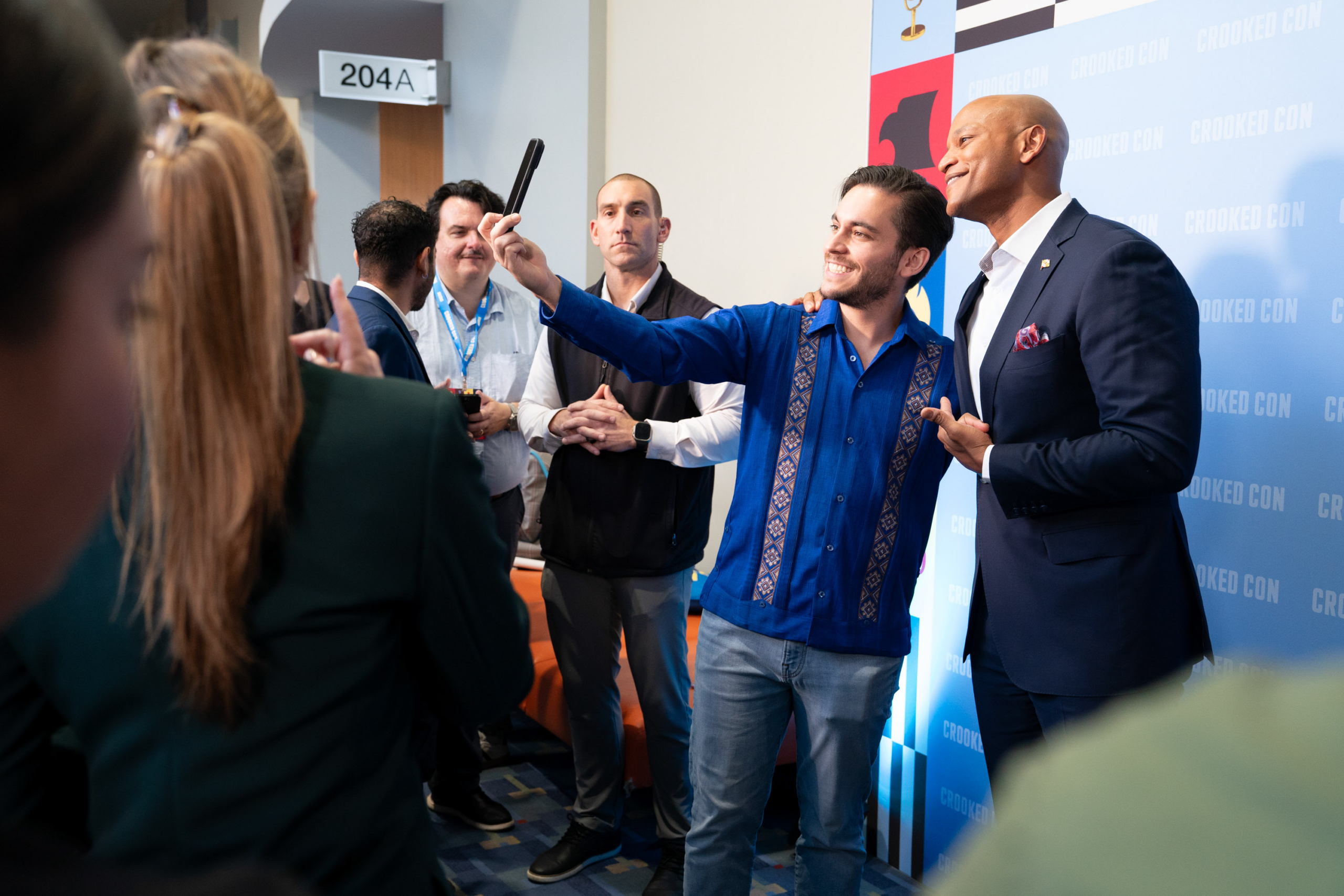
On Saturday, in downtown Washington, DC, six thousand people descended on Crooked Con, a political conference hosted by Crooked Media—the company founded by former Obama administration staffers Jon Favreau, Jon Lovett, and Tommy Vietor, best known for Pod Save America. Hanging from the ceiling was a blue sign: “The bigger the tent, the closer to God.” Jubilation was in the air, Beyoncé and Chappell Roan on the playlist. A ticket cost two hundred bucks. Between panels (“Making Liberalism Cool Again,” “From Anti-Trump to Pro-Something”) and smoothies in the MS Now Lounge, speakers made their way to the Take Center, where event organizers encouraged journalists and creators to produce and publish à la minute. Phone tripods were set up in front of branded Crooked Media backdrops that read “Freedom and Content for All.”
Barrett Adair, a political activist and social media content creator, spent most of her day at the Take Center. “There is a lot of conversation about ‘Oh, the right does the internet better’ and ‘They’re better with creators’ or whatever,” she told me, fiddling with large sunglasses. Turning Point USA’s AmericaFest convention—founded by Charlie Kirk, the right-wing influencer who was killed last year—predates Crooked Con, which debuted last November. But “by and large, they are not inherently better,” she added. “They just invested in the infrastructure earlier.”
Breeze Wood, a/k/a breezleweezle, and Bri Dineen, who posts as bri motherhood, agreed. Right-wing creators such as Alex Clark, who hosts a hit Turning Point podcast, Wellness Apothecary, often seem to dominate: Clark’s is among the ten highest-ranked shows in the health-and-fitness category on both Spotify and Apple. But Wood and Dineen think there’s room for different voices. “Like, you’re tradwife-adjacent,” Wood said to Dineen, “but not a tradwife.”
“That’s kind of where my whole account popped off. Like, I make sourdough. I grow my own vegetables,” Dineen, who is a registered nurse, said. “But we also get vaccines.”
Some politicians are learning to be creators, too. “Candidates are able to rely on their own social media strategies and their own media apparatus rather than some of that framing that is put onto them by mainstream media or paid advertisements,” said Chi Ossé, a New York City Council member who belongs to the Democratic Socialists of America, and who recently announced a new show on Crooked Media. “What this says to Democrats is, ‘Congratulations, you’re free now from being beholden to special interests,’ right? Whether it’s Lockheed Martin, whether it’s AIPAC, you can win if you have an organic following.”
Morris Katz, a partner at Fight Agency, a political consulting firm, took a bite of a cookie. Katz, who recently worked on ads for Gina Hinojosa, the first Democrat to be elected governor of Texas since 1990, is best known for his work on Zohran Mamdani’s successful mayoral bid in New York. The mainstream media, he said, tends to mislabel campaigns: “The progressive, moderate stuff is so disconnected from how voters actually interpret candidates.”
Is there still a role for the traditional press in political media? Lis Smith—a Democratic strategist who recently worked with James Talarico, the senator-elect, and Bobby Pulido, the congressman-elect, in Texas—thinks so, “even if it gets smaller every year,” she told me. “It’s still, for a lot of voters, the primary way of getting news, the most trusted way of getting news.” And, she noted, many big stories this cycle, such as the news about Senator Roger Marshall in Kansas suing patients for small medical debts, came out of newsrooms.
As the sun began to set outside, Megan Chopra, a political-media strategist and content creator who posts online as Megan Thuy, sipped a glass of white wine and puffed from a blue vape while her friend Scott F. Blue II, who streams as The Blue Broadcast on Twitch, sat across from her, drinking a Maker’s Mark–and-soda. “I didn’t want to be the asshole ordering an old-fashioned at the Crooked Media thing,” he said.
Chopra felt conflicted about the day’s festivities. She and Blue had joked about going to Crooked Con to “lib out,” but the party’s establishment, and the mainstream media, she felt, should not take credit for the work of grassroots organizers. After all, “the progressives won this,” she told me, “not Chuck Schumer.”
Blue agreed. “It feels good to coalesce together, pat ourselves on the back,” he said. And yet: “If we don’t make meaningful change, it’s going to swing back even harder the other way.”
Has America ever needed a media defender more than now? Help us by joining CJR today.